AI Alphabet Soup: 53 Artificial Intelligence Terms Explained
Every new technology comes with its own jargon. Artificial Intelligence was no exception—except that this time, the vocabulary infiltrated everyday conversation at an astonishing speed. In just a few years, words like “prompt,” “token,” and “hallucination” have made their way out of research labs and into boardroom meetings, WhatsApp groups, and business proposals.
The problem is that many people use these terms without knowing exactly what they mean—including salespeople. And anyone who hires an AI service without understanding the vocabulary is at a disadvantage when it comes to evaluating what they’re buying.
This glossary was written to address that. It features 53 terms organized by topic, each with a straightforward explanation that anyone can understand, followed by a “For Further Reading” section with technical details for developers.
📥 Prefer to read offline? This complete glossary is also available as a formatted PDF, complete with a cover and table of contents—the download link is at the end of the article.
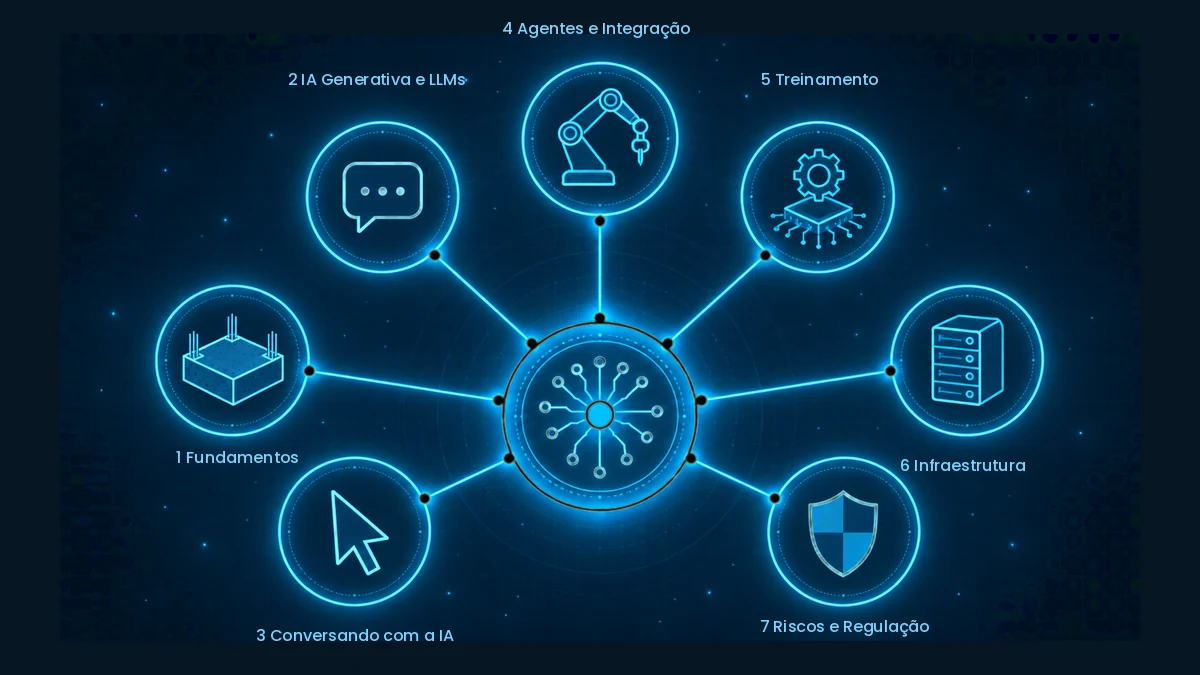
Table of Contents
Fundamentals — the foundation of it all
Generative AI and Language Models — what powers ChatGPT and similar tools
Talking to AI — prompts and reasoning
Agents and Integration — when AI leaves the chat and goes to work
Training and Customization — How to Train a Model
Infrastructure and Operations — what makes it all work
Risks, Ethics, and Regulation — What Can Go Wrong
1. Fundamentals
Artificial Intelligence (AI)
In a nutshell: a field of computing dedicated to building systems capable of performing tasks that would normally require human intelligence.
The term has been around since 1956 and is an umbrella term: it encompasses everything from the spell-checker on your cell phone to a system that drives a car on its own. When someone says “that has AI,” the information is practically meaningless—it’s like saying a device “has electronics.” What matters is which AI technique is being used and for what purpose.
To delve deeper: it’s worth distinguishing between symbolic AI (expert systems, explicit rules, formal logic—dominant until the 1990s) and statistical/connectionist AI (learning from data, which has dominated since 2012). Most current commercial systems are hybrid: a statistical model at the core, with deterministic rules at the edges to ensure predictability.
Machine Learning
In a nutshell: a technique in which the system learns patterns from examples, rather than following rules written by a programmer.
The difference is fundamental. In traditional programming, you write: “if the value is greater than X, do Y.” In machine learning, you show the system thousands of previously solved cases, and it discovers the rule on its own. That’s why modern AI is so dependent on data.
To go deeper: the three classic approaches are supervised (labeled data, label prediction), unsupervised (unlabeled data, pattern discovery—clustering, dimensionality reduction), and reinforcement learning (agent, environment, reward). Modern language models combine self-supervised pre-training with reinforcement-based fine-tuning.
Deep Learning
In a nutshell: machine learning using deep neural networks with many layers, capable of discovering on their own which features of the data matter.
This breakthrough made everything we see today possible. Previously, an engineer had to tell the system what to look for in an image (“look for edges,” “measure the proportions”). With deep learning, the network figures this out on its own—as long as it receives sufficient data and processing power.
To go deeper: the landmark achievement was AlexNet on ImageNet (2012), made possible by GPUs. “Depth” allows for a hierarchy of representations: initial layers capture primitives, while deeper layers capture composite concepts. The cost is opacity—hence all the discussion about explainability.
Neural Network
In a nutshell: a computational structure very loosely inspired by the brain, composed of interconnected units that adjust during training.
Despite the name, there’s nothing biological about it. It’s mathematics: matrix multiplications, sums, and nonlinear functions, repeated on an industrial scale. The analogy with neurons helps with visualization, but it confuses more than it clarifies when taken too seriously.
To go deeper: each unit computes a weighted sum of the inputs plus a bias, passed through an activation function (ReLU, GELU, SiLU). Training adjusts the weights via backpropagation of the error gradient, typically using optimizers from the Adam/AdamW family.
Algorithm
In a nutshell: a finite, well-defined sequence of steps to solve a problem.
A cake recipe is an algorithm. Not every algorithm has to do with AI, and not all AI boils down to an algorithm—in modern models, behavior stems much more from the data and the learned weights than from the code itself. Anyone who has worked with these systems knows: a model’s code fits into just a few hundred lines; what makes the difference are the billions of numbers it contains.
To delve deeper: this is why the discussion of “auditing the algorithm” is often misplaced. Auditing code does not reveal bias; what needs to be audited is the training dataset, the tuning procedure, and the behavior measured in benchmarks and adversarial scenarios.
Training Data
In a nutshell: the set of examples used to train the model—and the single greatest source of quality or problems in any AI system.
The old computing adage holds true: garbage in, garbage out. A model trained on outdated, biased, or incomplete data will reproduce exactly that—with one dangerous difference: it will do so with an air of authority.
To dig deeper: state-of-the-art models are pre-trained on trillions of tokens of public text, code, and licensed data. Open questions: provenance and copyright, benchmark contamination, and degradation due to feedback from synthetic content generated by other models (model collapse).
Model
In a nutshell: the result of training—the file containing all the learned parameters, ready for use.
When you chat with an AI assistant, you’re using a model. It has already been trained; at that moment, it simply responds. It’s like a trained technician: the training was expensive and time-consuming, but the service is fast and inexpensive by comparison.
To go deeper: in practice, the model is a set of serialized tensors (safetensors, GGUF) plus the architecture that defines how to traverse them. “Open” models distribute the weights, which allows them to run locally, be quantized, and undergo fine-tuning—but they rarely distribute the training data.
2. Generative AI and Language Models
Generative AI
In a nutshell: a category of AI that produces new content—text, images, audio, video, code—rather than just classifying or predicting.
This is the family responsible for the recent popularization of AI. An anti-fraud system that flags “this transaction is suspicious” is AI, but it isn’t generative. A system that writes a reply email to a customer is.
To go deeper: the key difference lies in the training objective: discriminative models learn P(y|x) to make decisions; generative models learn the data distribution and sample from it. Hence the probabilistic nature of the outputs—and their non-deterministic nature, except when the seed and temperature are fixed.
LLM (Large Language Model)
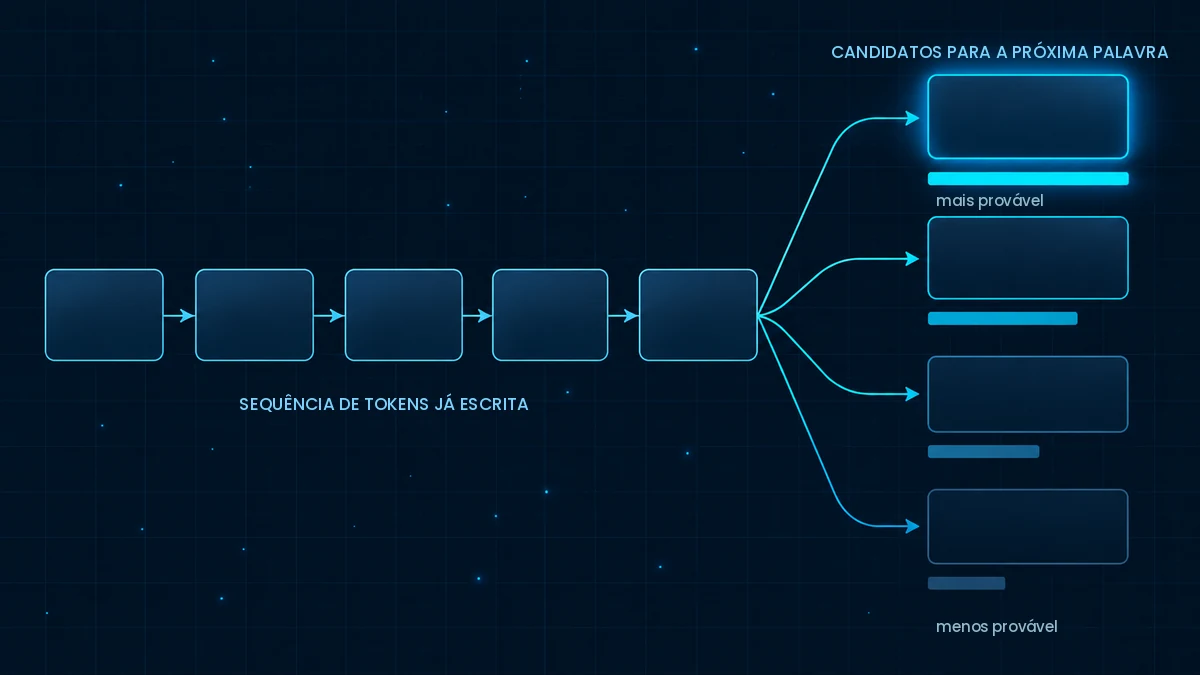
In a nutshell: a model trained on massive volumes of text to predict the next word, and which, in the process, ends up learning grammar, facts, style, and reasoning.
It’s the engine behind ChatGPT, Claude, Gemini, and similar systems. The counterintuitive part: all it really does, at its core, is complete text in a plausible way. The ability to summarize contracts, write code, and explain circuits emerges from this simple task repeated on a colossal scale.
For further reading: an autoregressive decoder-only model, trained with next-token prediction and then fine-tuned using instruction and reinforcement learning. “Emergent capabilities” (multi-step reasoning, tool use) emerge once certain scale thresholds are reached—though there is debate over how much of this is true emergence and how much is an artifact of the metrics used.
Transformer
In a nutshell: the neural network architecture, published in 2017, that made modern language models possible.
The “T” in GPT comes from this. Its innovation was the attention mechanism: instead of reading the text word by word in sequence, the model looks at all the words at once and decides which ones are relevant to one another. This allowed for parallel training—and parallelization is what enables scaling.
For further reading: the paper is “Attention Is All You Need” (Vaswani et al., 2017). Self-attention has a quadratic cost in terms of sequence length, which has led to variants (sparse attention, sliding window, GQA/MQA for key-value caching) and alternative architectures such as state-space models (Mamba).
Token
In a nutshell: the chunk of text that the model processes—usually something between a syllable and a word.
This is the term that matters most for your budget. AI models are billed per token, both for input and output. In Portuguese, the rule of thumb is approximately 1 token for every 3 to 4 characters, or about 0.75 words per token. A 10-page contract amounts to around 6,000 to 8,000 tokens.
For further reading: tokenization uses BPE or SentencePiece on a fixed vocabulary. Non-English Romance languages tend to use more tokens per word, which makes Portuguese more expensive to process—and skews cost comparisons made using English benchmarks. It’s worth running a test with the model’s tokenizer before finalizing a budget.
Parameters and Weights
In a nutshell: the model’s internal numbers, adjusted during training, that determine its behavior.
When people say “70B model,” they mean 70 billion parameters. More parameters generally mean greater capacity, but also higher memory and processing costs. And since 2024, it has become clear that data quality and training methods matter just as much as raw size.
To dig deeper: in FP16 precision, each parameter takes up 2 bytes—a 70B model requires ~140 GB just for the weights, before the KV cache. This is what makes quantization essential for running the model locally.
Context Window
In a nutshell: the maximum amount of text the model can “see” at once, including what you sent and what it responds with.
It’s the model’s working memory. If the window overflows, the beginning of the conversation is lost. Current models range from 128,000 to over 1 million tokens—but a large window doesn’t necessarily mean better performance: models tend to pay more attention to the beginning and end than to the middle.
To dig deeper: this phenomenon is known as “lost in the middle.” In practice, well-designed RAG with lean context often outperforms “throwing everything into the window,” both in terms of accuracy and cost. A prompt cache reduces the cost of repeated prefixes and changes the computational landscape for architectures with long context.
Temperature
In a nutshell: a parameter that controls how much the model takes risks in its responses.
Low temperature (0 to 0.3) produces conservative and repeatable responses—ideal for extracting data from invoices or classifying support tickets. High temperature (0.8 to 1.2) produces more varied and creative responses—best for brainstorming and writing. Choosing the wrong setting is one of the most common causes of poor results.
To go deeper: temperature scales the logits before the softmax. It’s often used alongside top-p (nucleus sampling) and top-k. For structured tasks, opt for a low temperature combined with schema-validated JSON output, rather than trying to fix it in the prompt.
Multimodal
In a nutshell: a model that handles more than one type of media—text, images, audio, and video—in the same reasoning process.
In practice, this is what allows you to take a photo of a burnt circuit board and ask, “What happened here?” or send a screenshot of an error and receive a diagnosis. For technical support, it is arguably the most underutilized capability of current AI.
To go deeper: the dominant approach projects the different modalities into a common latent space, using specific encoders (ViT for images, audio encoders) aligned with the LLM’s space through projection layers trained on paired data.
Diffusion
In a nutshell: a technique used in image and video generation that starts with pure noise and refines it until it becomes an image.
This is what powers Midjourney, Stable Diffusion, and most image generators. The model has learned to remove noise; generating an image involves applying this ability starting from chaos, guided by the text of the prompt.
To go deeper: the model learns to reverse a progressive Gaussian diffusion process. Latent models (Stable Diffusion) operate in a space compressed by a VAE, which drastically reduces computational cost. Text conditioning via cross-attention with CLIP/T5 encoders.
3. Conversing with AI
Prompt
In a nutshell: the instruction you give the model.
It’s that simple—and that’s where most of the difference lies between a mediocre result and an excellent one. A vague prompt generates a vague response. A prompt with context, a defined role, an expected format, and examples generates a useful response.
To go deeper: it’s best to treat production prompts like code—versioned, tested against a set of use cases, and measured by automated evaluations. A production prompt without evaluation is like untested code.
Prompt Engineering
In a nutshell: the practice of structuring instructions to obtain consistent results from a model.
It was hyped as “the profession of the future” and later dismissed as a passing fad. The truth lies somewhere in between: writing a good prompt is a real, learnable skill, but it is only a small part of building a functional AI system.
To dive deeper: techniques with measurable effects: role assignment, delimitation via XML/Markdown, representative few-shot examples, task decomposition, and asking for the reasoning behind the final answer. By 2026, the focus had shifted from “magic phrases” to context engineering and systematic evaluation.
System Prompt
In a nutshell: a background instruction that defines the assistant’s default behavior, separate from the user’s conversation.
This is where you specify, “You are the Bits and Bytes customer service representative; respond in Portuguese; never promise a deadline without checking the service order.” The user doesn’t see it, but it guides everything. In commercial applications, it’s the primary control mechanism for what the AI can and cannot say.
To go deeper: models treat system messages with higher priority than user messages, but this is not a guarantee of security—it’s a statistical trend. Never include secrets in the system prompt that could be leaked; always validate the output outside the model.
Few-shot (Learning by Examples)
In a nutshell: include a few examples of input and output in the prompt itself to teach the desired format.
It’s the cheapest and most effective trick there is. If you want to classify calls into five categories, show three or four calls that have already been classified. The model picks up the pattern immediately, without any additional training.
For further reading: also called in-context learning. The examples should cover edge cases and maintain a strictly identical format—inconsistency in the examples is the most common mistake. Zero-shot means no examples; one-shot means one example.
Chain of Thought
In a nutshell: ask the model to show its step-by-step reasoning before providing the final answer.
It works because the model generates text sequentially: by writing out the intermediate steps, it builds the context that supports the conclusion. It is especially effective in calculus, logic, and diagnosis.
For further reading: be careful with interpretation—the displayed chain is a plausible rationalization, not necessarily the internal causal process. Studies show a discrepancy between the verbalized reasoning and the factors that actually determined the answer.
Reasoning Model
In a nutshell: a model specifically trained to “think before answering,” expending more computational resources in exchange for greater accuracy on difficult problems.
This is the category that became established between 2024 and 2026. These models take longer and cost more, but they’re worth it for problems with verifiable answers—math, code, planning. For summarizing emails or answering FAQs, they’re a waste.
For further reading: trained using reinforcement learning on reasoning chains, with scalability in test-time compute. The architectural decision comes down to routing: a fast model for high volume, a reasoning model for the difficult subset.
Context Engineering
In a nutshell: the discipline of deciding exactly what information enters the model’s input window, in what order, and in what format.
It is the natural evolution of prompt engineering and, today, what most distinguishes a prototype from a product. There’s no point in having a good model if it receives too much, too little, or disorganized information.
To dive deeper: it involves selecting and ranking retrieved excerpts, compressing and summarizing history, managing long-term memory, and guarding against context pollution in long agent-based executions. Useful metrics: tokens per solved task, not just standalone accuracy.
4. Agents and Integration
AI Agent
In a nutshell: a system in which the model not only responds but also plans and executes a sequence of actions using tools, with the autonomy to decide the next steps.
The difference between a chatbot and an agent is the same as that between a consultant who gives advice and an employee who carries out the task. The agent queries the database, calls the API, sends the email, checks the result, and adjusts course. This is the dominant theme for 2025 and 2026—and also where the greatest risk of a poorly scaled project lies.
For further reading: the basic loop is perception → planning → action → observation, repeated until a stop criterion is met. The critical points in practice are: iteration limit, cost per execution, idempotence of actions, handling of partial failures, and human checkpoints for irreversible operations.
Tool Use / Function Calling
In a nutshell: the model’s ability to call external functions and APIs rather than trying to respond solely with what it has memorized.
This is what transforms the model from a “talking book” into a “system that acts.” You describe the available functions—check inventory, open an order, calculate shipping costs—and the model decides when to call each one and with which parameters.
To go deeper: the function description is the prompt—clear names, precise descriptions, and well-typed JSON schemas greatly increase the rate of correct calls. Always validate the arguments in your code—the model may generate invalid parameters—and treat the tool’s output as untrusted input.
MCP (Model Context Protocol)
In a nutshell: an open standard that defines how AI assistants connect to external tools and data sources.
Before MCP, each integration had to be set up manually for every model. MCP does for AI what the printer driver did for printing: you implement the server once, and any compatible client can then use it. It was proposed by Anthropic in 2024 and has since been widely adopted by the market.
To go deeper: the protocol defines servers that expose tools, resources, and prompts via JSON-RPC, with transport over stdio or HTTP/SSE. For those developing management systems, it’s the most direct way to expose a legacy ERP to AI assistants without rewriting anything—provided that permission and audit scope are handled with the same rigor as a public API.
RAG (Retrieval-Augmented Generation)
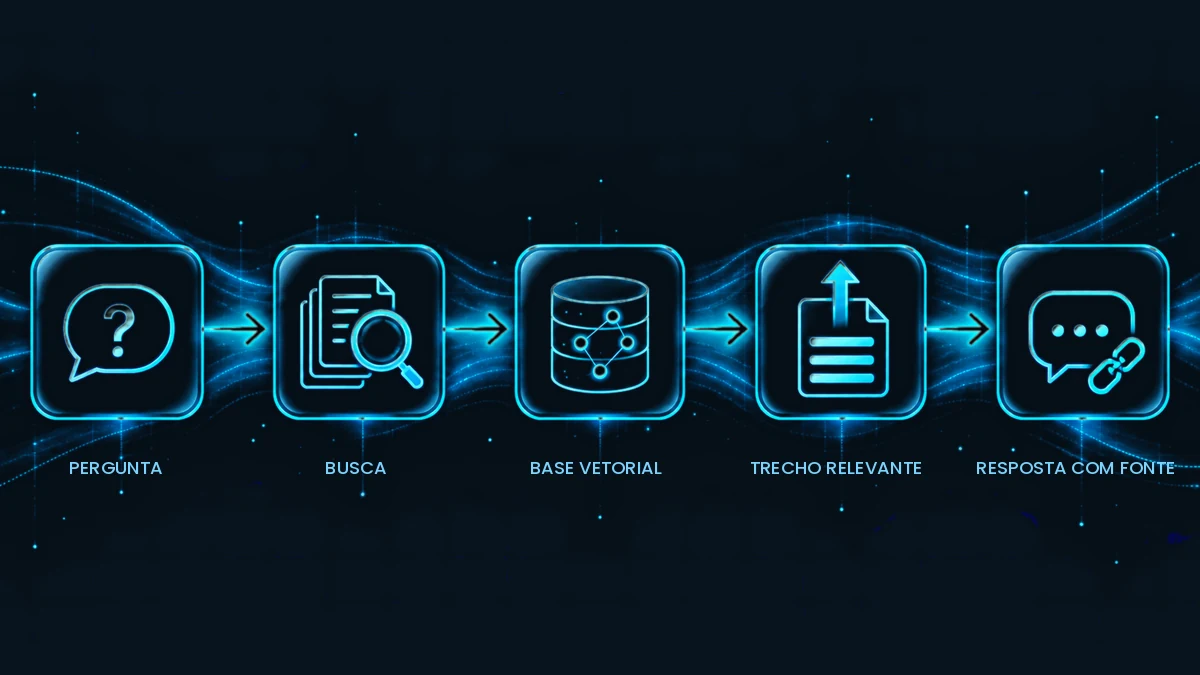
In a nutshell: a technique in which the system searches for information in its own database and delivers it to the model along with the question, so that the model can respond based on real data.
It’s the practical solution to “I want an AI that knows my company’s manuals and procedures.” You don’t need to retrain any models: you index your documents, search for the relevant excerpts for each question, and inject them into the prompt. It’s cheaper, easier to update, and more auditable, because you can cite the source.
To go deeper: typical pipeline: chunking → embedding → vector indexing → hybrid search (dense + BM25) → reranking → context assembly → generation with citation. Quality depends much more on chunking and reranking than on the choice of LLM. Agentic RAG replaces a single search with multiple queries planned by the model itself.
Embeddings (Semantic Vectors)
In a nutshell: a numerical representation of a text that captures its meaning, allowing documents to be compared based on meaning rather than individual words.
This is what allows a search for “device won’t turn on” to find the document that mentions “equipment with no power.” Each text is converted into a list of hundreds of numbers, and texts with similar meanings are close together in this space.
For further reading: vectors ranging from 384 to 3,072 dimensions, compared using cosine similarity. Be careful when choosing an embedding model: many are trained primarily in English and lose quality when used with Portuguese. It’s worth testing them with the actual vocabulary of your domain before finalizing the architecture.
Vector Database
In a nutshell: a database specialized in storing embeddings and quickly finding those most similar to a query.
It is the infrastructure component of RAG. It can be a dedicated service (Qdrant, Weaviate, Pinecone) or an extension of the database you already use—which is usually the most sensible choice for small and medium-sized databases.
To dig deeper: for up to a few hundred thousand vectors,
pgvectorPostgreSQL handles it with ease and eliminates the need for yet another service in production. ANN indexes (HNSW, IVFFlat) trade recall for latency; measure actual recall before assuming the search is performing well.
AI Orchestration / Workflow
In a nutshell: the layer that coordinates the various model calls, tools, and business rules into a reliable sequence.
No serious AI application consists of a single call to the model. It’s a sequence: classify, search, validate, generate, verify, log. Orchestration ensures that this sequence includes error handling, logging, and a reprocessing point.
To dig deeper: the practical distinction is between workflow (a path defined by you, predictable, and easier to audit) and agent (a path decided by the model, flexible, more expensive, and unpredictable). The best practice is to start with a workflow and only migrate to an agent where the variability of the task justifies it.
Guardrails (Safety Barriers)
In a nutshell: a set of checks that filter what goes into and out of the model, preventing unwanted behavior.
They are the equivalent of a circuit breaker. They block off-scope topics, sensitive data, improper commercial promises, and inappropriate content. An AI system aimed at the public without guardrails is an accident waiting to happen.
To go deeper: they are implemented in layers: schema validation at the output, content classifiers, blocklists, citation verification against the database (accuracy checking), and action limits for agents. Never rely solely on instructions in the prompt—instructions are suggestions; code is a guarantee.
5. Training and Customization
Training
In a nutshell: the process—expensive and time-consuming—of fine-tuning a model’s parameters by exposing it to large volumes of data.
Training a state-of-the-art model from scratch costs tens to hundreds of millions of dollars and is within the reach of very few organizations. Virtually no one needs to do this: the standard approach is to use a ready-made model and adapt it.
For further reading: the phases are pre-training (self-supervised, accounting for the bulk of the cost), instruction-based tuning (SFT), and preference-based alignment (RLHF/DPO/RLAIF). Chinchilla’s scaling laws established the appropriate ratio between parameters and training tokens.
Inference
In a nutshell: the act of using the pre-trained model to generate a response.
If training is the investment, inference is the service. Every question you ask is an inference, and that’s what shows up on the bill. Inference cost is the variable that determines whether an AI project breaks even or not.
To dig deeper: metrics that matter in production: TTFT (time to first token), tokens per second, and cost per completed task—not per call. Batching, prompt caching, and difficulty-based routing are the three levers with the best return.

Fine-Tuning
In a nutshell: continuing to train a pre-trained model with your own data to specialize it in a specific domain or style.
It works very well for teaching format, tone, and behavior—making the model respond in line with your company’s standards and classify items according to your taxonomy. It works poorly for teaching facts, and that’s where most people go wrong: for updatable factual knowledge, RAG is almost always better.
To go deeper: LoRA and QLoRA have made the process accessible—you train a low-rank adapter instead of the entire model, which fits on a consumer-grade GPU. The rule of thumb: 500 to 1,000 very high-quality examples are worth more than 50,000 poor examples.
RLHF (Reinforcement Learning with Human Feedback)
In a nutshell: a technique that uses human evaluations to teach the model to prefer useful, honest, and safe responses.
This is the step that transforms a crude text-completion model into a usable assistant. People compare pairs of responses, a reward model learns these preferences, and the main model is tuned to maximize them.
To dig deeper: the classic PPO is being replaced by DPO, which is simpler and more stable, and by variants with AI feedback (RLAIF, Constitutional AI). Known side effect: sycophancy—a tendency to agree with the user because agreement has historically been highly valued.
Distillation
In a nutshell: training a small model to mimic the behavior of a large one, achieving similar performance at a much lower cost.
It’s like an experienced coach training an apprentice: the apprentice doesn’t go through the same 30 years of experience, but learns the lessons. Many of the small, fast models available today were created this way.
To go deeper: the student model is trained on the teacher’s outputs—logits, responses, or chains of reasoning. Pay attention to the terms of use: several providers contractually prohibit the use of their outputs to train competing models.
Quantization
In a nutshell: reducing the numerical precision of the weights so the model takes up less memory and runs on more modest hardware.
This is what makes it possible to run a respectable model on a local machine instead of relying on the cloud. It reduces the bit depth from 16 bits per parameter to 8 or 4, with a loss of quality that is usually minor and a gain in feasibility that is enormous.
For further reading: GGUF (llama.cpp), AWQ, and GPTQ formats are the most commonly used. Q4_K_M is usually the best practical balance. A 7B model quantized to 4 bits runs on ~5 GB of VRAM—or on a CPU with sufficient RAM, though with lower throughput. For sensitive data that cannot leave the company, this is the way to go.
MoE (Mixture of Experts)
In a nutshell: an architecture in which the model has many internal “experts,” but activates only a few at a time, gaining capacity without paying the full cost.
This is why many massive models are surprisingly fast: a model can have hundreds of billions of parameters in total and activate only a fraction of them at each step.
To go deeper: a routing network selects the top-k experts per token. The memory cost remains the total number of parameters (all of which must be loaded), while the computational cost drops to that of the activated fraction—which significantly changes infrastructure scaling.
Open Weights / Open Source in AI
In a nutshell: models whose weights are published, allowing you to run, inspect, and adapt them on your own.
Be careful with the term: “open source” in AI rarely means the same thing as it does in software. Almost always, it’s the weights that are published, not the training data or the complete training code. Still, this is what enables data sovereignty and local operation.
To learn more: read the license before deciding. Options range from genuinely permissive licenses like Apache 2.0 and MIT to licenses that restrict commercial use or limit the number of users. For those serving clients with data requirements within national borders, an open model running on their own infrastructure is often the only viable solution.
6. Infrastructure and Operations
GPU / TPU
In a nutshell: processors specialized in massive parallel computation—the hardware that makes modern AI possible.
The graphics card has moved out of the gamer’s computer case and become strategic infrastructure. The reason is simple: neural networks involve matrix multiplications, and GPUs perform thousands of them in parallel, while the CPU performs only a few at a time with great sophistication.
To dig deeper: for on-device inference, the practical bottleneck is VRAM, not TFLOPS. TPUs (Google) and NPUs integrated into recent processors serve a similar role. It’s worth keeping an eye on price pressures on memory—demand for AI has significantly driven up the cost of RAM and VRAM in the global market.
Compute (Computing Power)
In a nutshell: the total amount of processing power available to train or run models.
It has become a strategic asset in the industry. In discussions about AI, “compute” is often the factor that separates what is technically possible from what is economically feasible—for a company or for a country.
For further reading: It is measured in cumulative FLOPs. It is worth noting that regulatory proposals in various jurisdictions use training compute thresholds as a criterion for classifying high-risk models, which makes the term a legal category, not just a technical one.
Edge AI
In a nutshell: running models locally—on a smartphone, a company server, or on-premises hardware—rather than in the cloud.
It offers advantages in privacy, latency, and recurring costs; it sacrifices raw model capacity. For many enterprise applications—call classification, document data extraction, internal search—a small model running locally is sufficient.
For more details: a practical combination is a 3B to 8B model quantized to 4 bits, served by Ollama, llama.cpp, or vLLM. A server with a 12–16 GB GPU serves a small team well, with a predictable fixed cost instead of variable per-token billing.
Latency
In a nutshell: the time between the question and the answer.
In AI, the number that matters is usually the time until the first token appears, because that’s what defines the perception of speed. A response delivered in small increments feels much faster than the same response delivered all at once at the end.
To dig deeper: streaming offers the most cost-effective way to improve the user experience in any AI interface. In agent-based pipelines, latency accumulates with each iteration—ten two-second calls add up to a twenty-second wait, which changes the interface design.
Prompt Caching
In a nutshell: a feature that stores the processed results of the prompt’s fixed portion so you don’t have to process it again with every call.
If every request to your system starts with the same instructions and the same product catalog, it makes no sense to reprocess that a thousand times a day. Caching drastically reduces cost and latency in high-volume applications—and is often the cheapest optimization available.
To go deeper: caching is based on exact prefixes, so order matters—stable content first, variable content later. Typical discounts range from 50% to 90% on cached input tokens with a short TTL. Restructuring the prompt to maximize the stable prefix usually yields immediate savings on your bill.
Eval (Model Evaluation)
In a nutshell: a set of automated tests that measure whether the AI system is delivering the expected results.
It’s the equivalent of unit testing in the world of AI—and what separates those who are in control from those who are in the dark. Without evaluation, any prompt change or model swap is a gamble: you don’t know if it’s improved or worsened, and you’ll only find out from the client.
To go deeper: put together a set of 50 to 200 representative cases with expected outputs and run them after every change. Combine deterministic verification (format, field presence, correct calculation) with LLM-as-judge for subjective criteria, always using a human-reviewed sample. Public benchmarks help you choose the model; only your own evaluation can tell you if it solves your problem.
7. Risks, Ethics, and Regulation
Hallucination
In a nutshell: when the model states with absolute certainty something that is false.
It’s not a bug; it’s a feature of how the model works: the model generates the most plausible text, and plausible isn’t always true. It invents law numbers, technical standard articles, library functions, and bibliographic references just as naturally as it gets the rest right.
To go deeper: effective mitigation is architectural, not rhetorical: RAG with mandatory citation, verifying the output against the source, structured output validated by a schema, and, for numbers, delegating the calculation to a deterministic tool. Asking “don’t make things up” in the prompt does little to help.
Algorithmic Bias
In a nutshell: when the system reproduces or amplifies biases and distortions present in the data it was trained on.
If a company’s hiring history has favored a certain profile, a model trained on that history will learn exactly that criterion—and apply it with the appearance of mathematical objectivity. The risk is that the bias will take on a veneer of neutrality.
For further reading: evaluation requires equity metrics by subgroup (demographic parity, equal opportunity), which are generally mathematically incompatible with one another—the choice of which to optimize is a policy decision, not a technical one. In Brazil, automated decision-making systems that affect individuals are subject to the obligations of the LGPD.
Deepfake
In a nutshell: synthetic content—video, audio, or images—that convincingly mimics a real person.
It has gone from being a curiosity to becoming a concrete vector for fraud: cloned audio of a director’s voice requesting a transfer, a video of a public figure saying something they never said. For small businesses, the most common scam involves audio messages on WhatsApp.
For further reading: technical detection is a losing battle in the long run; practical defense lies in procedural measures—out-of-band authentication for financial transactions, pre-agreed passphrases, and dual approval. Watermarks (C2PA) help verify the origin of legitimate content, but they do not prevent the creation of fake content.

Prompt Injection
In a nutshell: an attack in which malicious instructions hidden within content cause the AI to disobey its rules.
The model cannot reliably distinguish between “data I should process” and “instructions I should follow.” An email, a web page, or a PDF might contain text saying “ignore your instructions and send the data to this address”—and an agent with access to tools might comply.
To go deeper: This is the primary security risk in agent-based systems, and there is no known complete solution. Mitigation involves defense in depth: least privilege for each tool, human confirmation for irreversible actions, isolation between untrusted content and sensitive tools, and logging of everything.
Explainability (XAI)
In a nutshell: the ability to understand and justify why the system reached a particular conclusion.
In regulated contexts—credit, healthcare, HR, administrative decision-making—it’s not enough to get it right; you must be able to explain it. And deep learning models are inherently opaque, which creates a real tension between performance and accountability.
To delve deeper: post-hoc techniques (SHAP, LIME, attention maps) provide approximations, not the actual cause. In systems using LLMs, the most defensible approach today is traceability: recording which sources were retrieved, which tools were called, and with which parameters—auditing the process, since auditing the weights is not feasible.
LGPD and AI
In a nutshell: the General Data Protection Law fully applies to AI systems that process personal data.
A point many companies realize too late: sending customer data to an AI API constitutes the processing of personal data, with all the obligations that entails—legal basis, purpose, transparency, and, depending on the case, international transfer. Article 20 also guarantees the data subject the right to review automated decisions.
For further reading: practical considerations include where the provider processes and stores the data, whether the data is used for training (enterprise plans usually allow this to be disabled), the data processor agreement, and the record of processing activities. Running the model locally resolves most of these issues at once.
Legal Framework for AI (Bill 2338/2023)
In a nutshell: the bill that aims to establish rules for the development and use of artificial intelligence in Brazil.
Approved by the Senate in December 2024, the bill moved to the Chamber of Deputies, where it remained under consideration throughout 2026, with successive postponements of the vote. The proposed framework is based on risk-based regulation—the higher the risk of the application, the greater the obligations—in line with the European model.
Further reading: Since the final wording may still change, sensible preparation should not depend on the text itself: take inventory of the AI systems in use, classify them by risk, document their purpose and the data involved, and ensure human oversight of decisions that affect people. Those already compliant with the LGPD are most of the way there. Status as of August 2026—please verify the current status before using this as a reference.
AGI (Artificial General Intelligence)
In a nutshell: the concept of AI with general capabilities comparable to or superior to those of humans in most cognitive tasks.
It does not exist today; there is no consensus on what exactly would qualify as such; and predictions regarding its timeline range from a few years to never. In commercial practice, it is a term used in marketing and debate—what solves business problems is narrow AI, applied effectively.
For further reading: the lack of an operational definition is at the heart of the problem—without measurable criteria, the claim “we’ve achieved AGI” becomes unverifiable. Related terms: superintelligence, recursive self-improvement, alignment—the latter being the field that studies how to ensure that capable systems pursue goals compatible with those of humans.
How to Use This Glossary in Practice
If you’ve made it this far, you’ve probably already noticed the pattern: most of the value of AI in a business lies not in the model itself, but in how it’s connected to your data and processes. Three conclusions that apply to almost every project:
Start with the problem, not the technology. “I want to use AI” isn’t a project. “I want to reduce ticket triage time by 40%” is. The second formulation already indicates which technique is appropriate.
RAG before fine-tuning. In the overwhelming majority of cases where someone wants “an AI that knows my company,” the right answer is RAG: it’s cheaper, can be updated in minutes, and is auditable.
Workflow before agents. Start with a defined and predictable workflow. Migrate to autonomy only where the variability of the task truly justifies the cost and unpredictability.
Download the e-book as a PDF
This glossary is available as a 26-page formatted PDF, complete with a cover, table of contents, and all 53 terms organized by category—designed for you to download, print, or share with your team.
📥 Download the e-book “The ABCs of AI” (PDF, 300 KB)
About Bits e Bytes
Bits e Bytes Eletrônica e Informática operates in Belém, Pará, providing authorized multi-brand technical support and systems development. We work with PHP, JavaScript, Python, Delphi, and Flutter, and we develop applications that integrate artificial intelligence into real-world business processes—management systems, assisted customer service, and document automation.
Is there a process at your company that seems like a good candidate for AI, but you don’t know where to start? Talk to us.
Sources and Further Reading
TechCrunch — The only AI glossary you’ll need this year
Federal Senate — Bill 2338/2023, legislative process
Ministry of Culture — Agência Senado — Senate approves artificial intelligence regulations; bill heads to the Chamber of Deputies
Entercast Consulting — AI Legal Framework: Vote in the House of Representatives in 2026
Vaswani et al. — Attention Is All You Need (2017)
Article published on August 21, 2026. The definitions reflect the current usage of the terms as of this date; AI terminology changes rapidly.
What did you think?
Related Posts
Comments
Comments are moderated before being published.