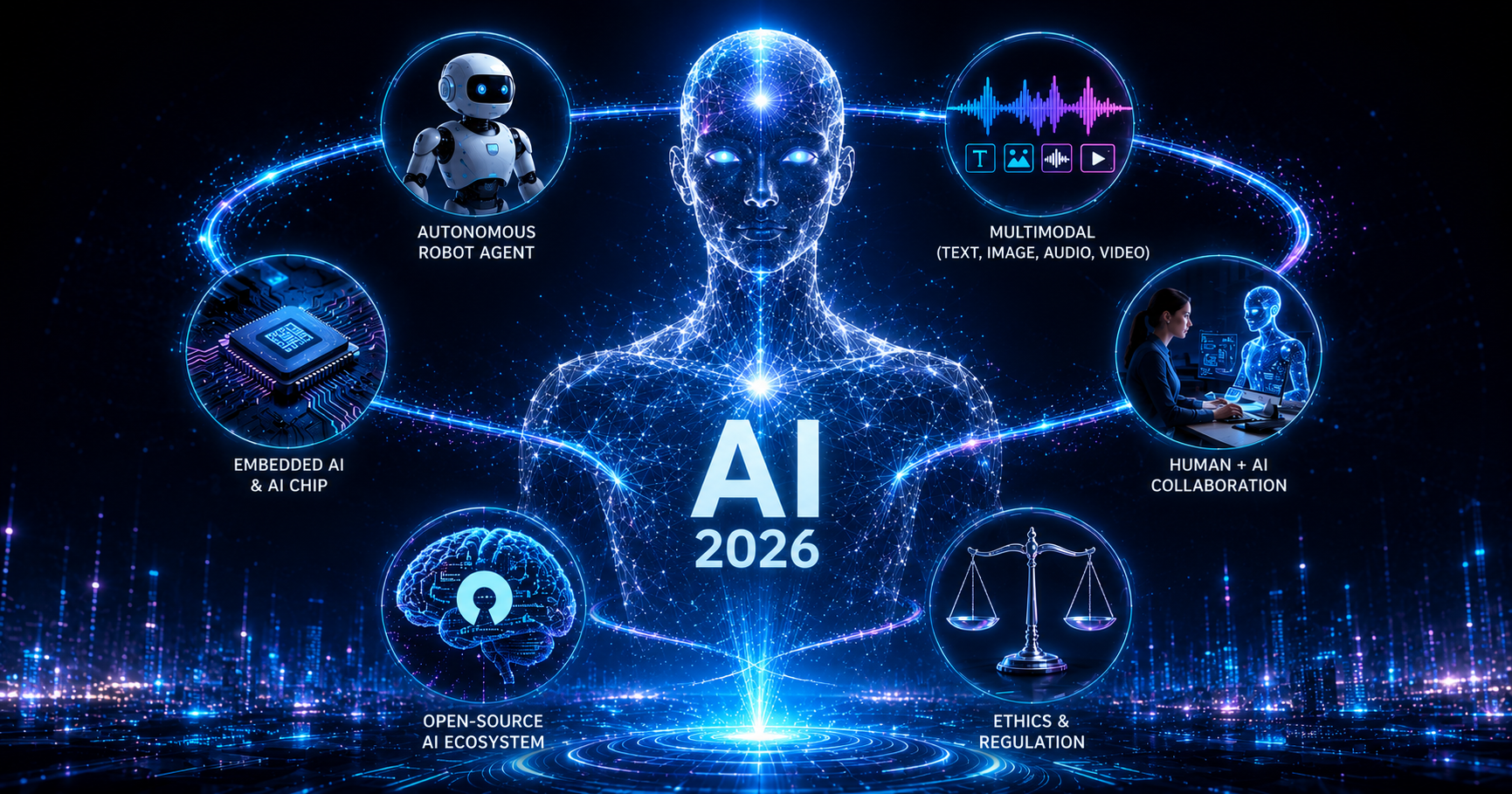
AI in 2026: The 6 Trends That Will Transform Technology (and Your Daily Life)
Artificial intelligence is no longer just a promise. By 2026, it will already be part of the daily lives of companies, developers, and even those who have never written a line of code. But the pace of evolution shows no signs of slowing down—on the contrary, this year brings changes that will redefine what we expect from machines.
In this article, we’ve compiled the six most relevant AI trends of 2026—with a focus on what really matters to those working in technology in Brazil.
1. Autonomous Agents: AI That Acts Without Waiting for You
AI assistants have evolved. Whereas they used to answer questions, they now perform complete tasks autonomously: they research, make decisions, interact with external systems, and deliver results. Tools like AutoGPT, CrewAI, and the new agent models from OpenAI and Google are already making this a reality.
2. Multimodal AI: Text, Images, Audio, and Video All at Once
The most advanced models of 2026 aren’t limited to text—they understand and generate content in multiple formats simultaneously. GPT-4o, Gemini 1.5, and Claude Sonnet are already demonstrating this capability, which is likely to become standard in the coming months.
3. On-Device AI: Intelligence on Devices, Without Needing the Cloud
Chips like the Apple Neural Engine and open-source solutions for Raspberry Pi and ESP32 enable voice recognition, computer vision, and real-time data analysis—without an internet connection, with minimal latency, and with complete privacy. For makers and electronics enthusiasts, this field is becoming increasingly accessible.
4. AI at Work: Co-Pilot, Not Replacement
According to McKinsey, 9 out of 10 companies plan to increase their investments in AI by 2027. Tools like GitHub Copilot, Cursor, and Codeium are already standard among programmers. In Brazil, demand is growing for professionals who know how to use AI as a tool—not just developers, but designers, analysts, and technicians.
5. Open-Source Models: Powerful AI Without a Subscription
Models such as Llama 3, Mistral, Phi-3, and DeepSeek offer performance comparable to commercial models and can run locally on your computer. With tools like Ollama or LM Studio, running an LLM locally is already an accessible reality, even with mid-range hardware.
6. Ethics and Regulation: AI Under Scrutiny
In Brazil, the Legal Framework for AI is moving forward in Congress. In Europe, the AI Act is already in effect. The technology professional of 2026 needs to understand not only how AI works, but how it should be used—algorithmic bias, transparency, and data protection are issues that are here to stay.
Conclusion
AI in 2026 is more capable, more accessible, and more integrated into everyday life than ever before. In upcoming Bits and Bytes articles, we’ll dive into each of these areas with hands-on projects, tutorials, and real-world experiments. Stay tuned!
Do you already use any AI tools in your work or projects? Let us know in the comments!
What did you think?
Related Posts

Comments
Comments are moderated before being published.