The TV Motor Was Working—and Other Lessons About Tools and Knowledge By Carlos — Bits and Bytes: Electronics and Computing
Once, a man came into my workshop carrying a CRT television. Before I even opened the workbench, he had already given me his diagnosis:
“It must be an easy fix, young man. The motor’s running.”
I was curious. TVs don’t have motors. I asked him how he’d come to that conclusion.
“I can hear it going ‘po, po, po’…”
The sound he was hearing was the flyback transformer discharging—the high-voltage transformer responsible for generating the thousands of volts that made the image appear on the tube. To him, anything that made a noise was a motor. And if the motor was running, the problem couldn’t be that serious.
I laughed at the time. But after more than forty-five years in this profession, I’ve learned that this story repeats itself in different forms—and the most recent one involves artificial intelligence.
The Multimeter That Pinpointed the Fault
A few years ago, it was common for customers to come in with a suspicious look and ask:
“You have that little gadget that pinpoints the problem, don’t you?”
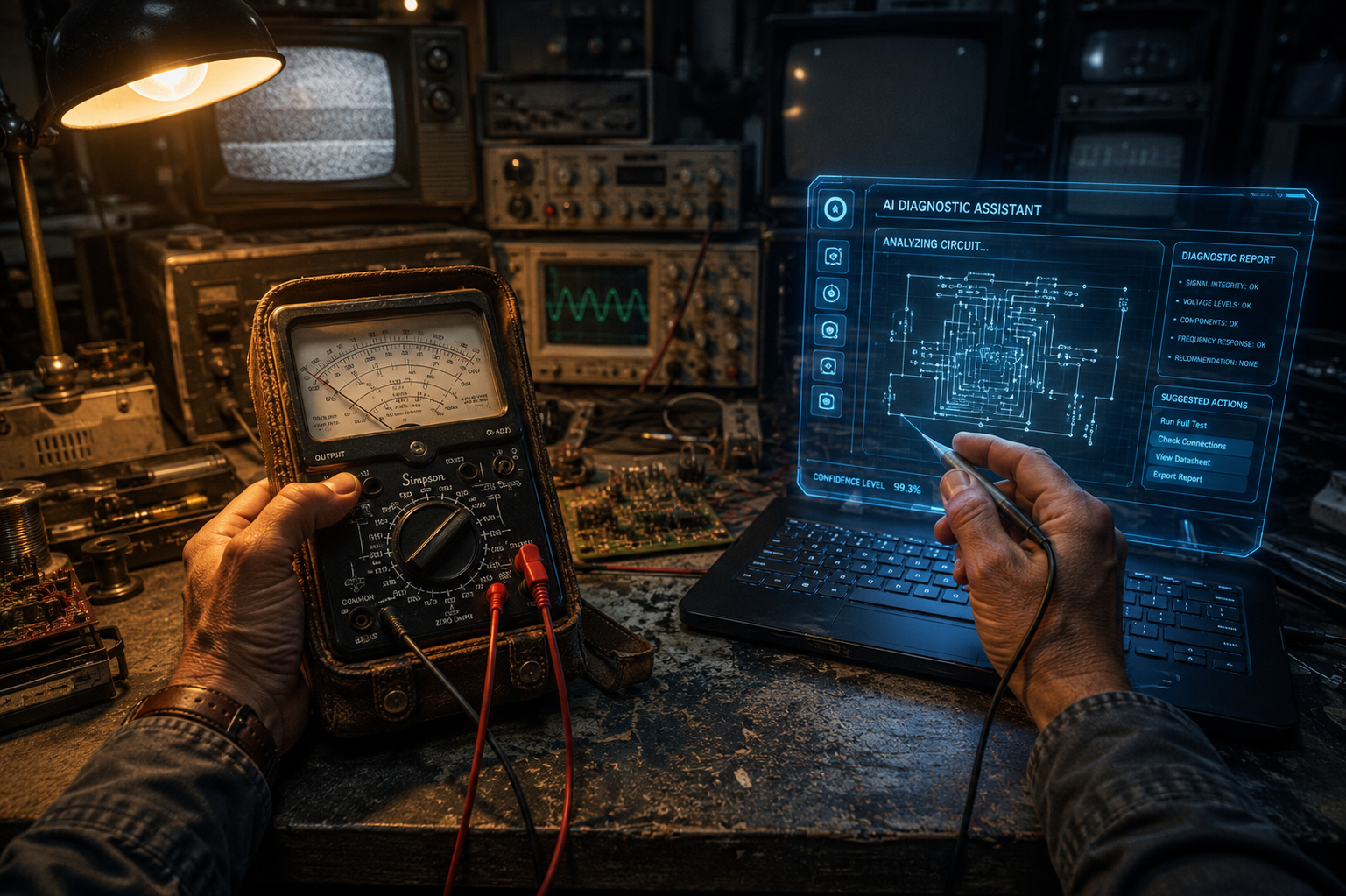
They were referring to the analog multimeter. That pointer-style instrument, full of scales, that seemed mysterious enough to be magical. The idea was simple: the device knew where the problem was, and the technician was just the one who touched the probes to the circuit.
What the customer didn’t see was the knowledge behind those measurements—knowing where to measure, what to measure, how to interpret the result, and what to do with it. The multimeter alone does nothing. In the wrong hands, it confirms what you want to believe, not what’s actually happening. In the right hands, it reveals what the equipment is trying to tell you.
AI Is the New Multimeter
Today, the situation has become much more sophisticated, but the customer’s logic remains the same.
Artificial intelligence is everywhere—on your cell phone, on your computer, in free tools accessible to anyone with an internet connection. The interface is simple: a text box. You type, it responds. It seems too easy to be a skill.
And that’s where the misconception begins.
Clients, colleagues, and even professionals from other fields have come to believe that anyone, with the right AI, can do anything. Develop a system? AI does it. Diagnose a circuit? AI handles it. Create a website, draft a contract, analyze complex data? Just ask.
What they don’t see is what lies behind the text box: years of experience in formulating the right question, in recognizing when the answer is wrong, in adapting the result to the specific reality of the problem, and in knowing what to do with what the tool has delivered.
AI, like a multimeter, is a tool. An extraordinarily powerful tool—but still just a tool.
The Difference Knowledge Makes
When I place the multimeter probes on a circuit, what determines the value of that measurement isn’t the device—it’s what I know about the circuit, about the suspect component, about the expected values under normal conditions, and about the variations that indicate a fault.
Similarly, when I use AI in systems development or in the analysis of technical problems, what determines the quality of the result is what I bring to the table: the context, the well-defined problem, my mastery of the subject, and the ability to critically evaluate what has been generated.
AI in the hands of someone who doesn’t understand the subject will produce answers that seem correct but may be completely wrong. Just like the multimeter showing a voltage that makes sense to someone who doesn’t know how to interpret it—and makes no sense at all to someone who understands the circuit.
The Value of the Professional Hasn’t Changed. The Tool Has.
The man from the TV station left with a much clearer understanding of what the “motor” of his device actually was. The flyback transformer, incidentally, was indeed the problem—and the repair required much more than just tightening a screw.
Forty-five years in the repair shop have taught me one thing that no tool will ever change: technical knowledge isn’t in the instrument. It’s in the person using it.
Artificial intelligence is here to expand what well-trained professionals can do. It’s not here to replace what they know.
The difference between using AI as a sophisticated calculator and using it as a genuine extension of your professional capabilities is exactly the same as the difference between touching the multimeter probes to just any spot and knowing exactly where to measure—and why.
Carlos is a systems analyst and electronics technician with over 45 years of experience. He is the founder of Bits e Bytes Eletrônica e Informática in Belém, Pará.
What did you think?
Related Posts
Comments
Comments are moderated before being published.